How to Build a Successful Fantasy Football Team: A Practical Strategy Guide

Building a successful fantasy football team requires more than choosing famous players. Strong results come from combining a clear understanding of the rules with disciplined budget management, reliable minutes, favourable fixtures, and regular but measured decision-making.
This guide presents a repeatable framework for selecting your squad, evaluating football statistics, choosing a captain, managing substitutes, and making transfers without reacting emotionally to every matchday.
Understand the Fantasy Football Rules and Scoring System
The fantasy football scoring system determines which player traits have the greatest value, so learn the rules before spending your player budget. Points for goals, assists, clean sheets, saves, bonuses, appearances, and defensive actions can change the ideal squad structure.
Every platform has its own rules. Some fantasy football games reward tackles, interceptions, key passes, or progressive passing, while others focus mainly on goals, assists, clean sheets, and playing time. Penalties for yellow cards, missed chances, own goals, or conceding goals also affect player selection.
- Position requirements: Check the number of goalkeepers, defenders, midfielders, and forwards required.
- Budget rules: Confirm the total player budget, price changes, and whether unused funds can be carried over.
- Transfer limits: Identify free transfers, transfer penalties, and available wildcard or reset options.
- Bonus rules: Learn how bonus points, player-of-the-match awards, or captain multipliers work.
- Formation rules: Know the minimum and maximum players allowed in each position.
Think of the scoring system as the game’s economy. A midfielder who regularly creates chances may be more valuable than a popular forward if the platform rewards key passes and attacking involvement. Before drafting, write down the scoring categories and rank them by their likely influence on total points.
Build a Balanced Squad Within Your Budget
A balanced fantasy football squad spreads its player budget across dependable starters, high-upside premium options, and affordable substitutes who are likely to play. Avoid investing so heavily in one position that injuries or rotation leave your team unable to field a competitive XI.
Start by identifying the players you consider essential. These might include one or two premium attackers, a reliable set-piece taker, or a defender with strong clean-sheet potential. Then fill the remaining positions with players who offer a combination of low cost, regular minutes, and a useful role.
A practical budget framework
- Premium core: Reserve money for two or three players with consistent attacking involvement or strong all-round scoring potential.
- Reliable mid-price players: Use this group to provide weekly flexibility across midfield, defence, and attack.
- Value picks: Select affordable starters rather than inactive bench players whenever possible.
- Bench depth: Keep at least one substitute who is highly likely to appear if a starter is unexpectedly absent.
Squad balance is about flexibility, not equal spending in every position. A cheap defender who starts every match can be more useful than an expensive defender with uncertain minutes. At the same time, choosing too many budget players can limit your captaincy options and reduce your ability to respond to favourable fixtures.
Use a simple test before confirming the squad: if one premium player becomes unavailable, can you replace them without taking a major points penalty or weakening two other positions? If the answer is no, the budget structure may be too concentrated.
Use Football Stats to Evaluate Players
Football statistics help you compare players by opportunity and expected involvement rather than reputation. Prioritise numbers that explain how often a player is on the pitch, involved in attacks, and positioned to earn the scoring actions your fantasy platform rewards.
Goals and assists matter, but they describe what has already happened. Combine them with underlying indicators to estimate whether a player’s role is likely to remain productive.
- Minutes and starting probability: A player who starts regularly usually offers a safer foundation than a more explosive rotation option.
- Shots and shots on target: These indicate attacking intent, especially when a player takes shots from dangerous areas.
- Expected goals and expected assists: These estimates measure the quality of chances a player receives or creates. They are useful signals, not guarantees.
- Touches in the penalty area: Frequent involvement near goal can reveal attacking potential before points arrive.
- Set pieces: Penalties, corners, and free kicks create repeatable opportunities for goals, assists, and bonus points.
- Defensive contributions: Tackles, clearances, interceptions, blocks, and recoveries matter when the scoring system rewards them.
- Consistency: A player producing moderate returns most weeks may be more valuable than one who alternates between a major haul and several blanks.
Compare players within similar positions and price ranges. For example, a midfielder with 80 percent starting probability, regular corner duties, and steady chance creation may be a better selection than a similarly priced attacker who has scored recently but rarely completes 60 minutes.
Statistics need context. A high expected-goals figure from one difficult match does not automatically make a player a long-term asset. Look at a reasonable sample, examine the player’s role, and check whether injuries, tactical changes, or new competition for places could alter the data.
Analyse Fixtures, Form, and Player Roles
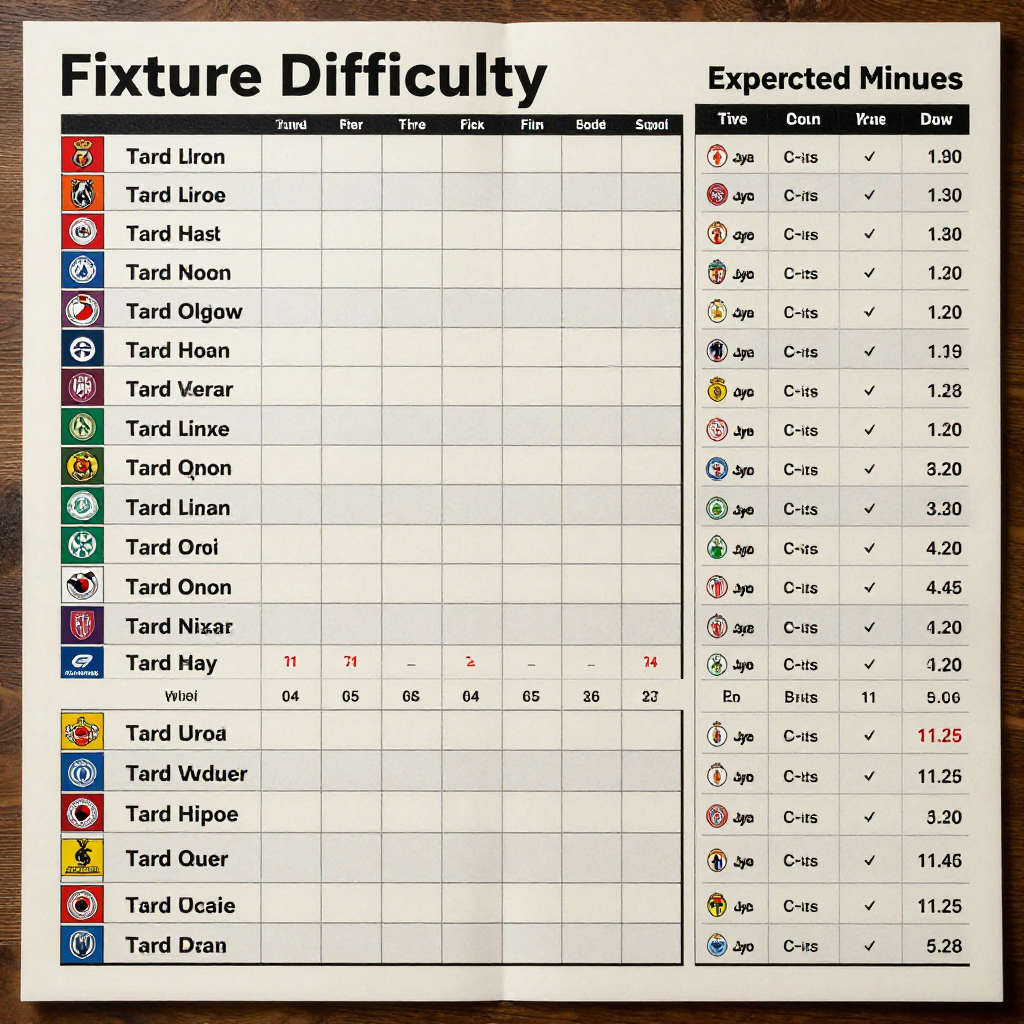
Fixture analysis shows when a player’s scoring environment may improve, while form and tactical role reveal whether that opportunity is likely to become fantasy points. Consider opponents, home and away performance, recent involvement, and expected minutes together.
Start with the next four to six fixtures, but avoid treating fixture difficulty ratings as absolute truth. A strong opponent may defend well yet concede chances from set pieces, while a supposedly easy opponent may play a deep defensive block that limits space.
- Upcoming fixtures: Assess defensive strength, attacking quality, travel demands, and the number of home matches.
- Home and away splits: Some teams create more chances at home, while others remain effective on the road.
- Current form: Review recent minutes, shots, chances created, clean sheets, and role changes rather than points alone.
- Player role: A winger moved closer to the striker, a full-back taking corners, or a midfielder playing behind the forward line may gain extra value.
- Team context: Injuries to teammates, congested schedules, and changes in manager or formation can affect opportunity.
Form should be treated as evidence, not a verdict. A player with three consecutive returns may have benefited from penalties or unusually efficient finishing. Conversely, a player with no recent points may still be attractive if their minutes, chances, and role remain strong.
Choose Your Starting XI, Captain, and Bench
Choose your starting XI by prioritising reliable minutes, strong fixtures, and attacking or defensive roles; choose your captain from the player with the best combination of ceiling, opportunity, and consistency. The bench should protect you from late team news without consuming too much budget.
A matchday decision process
- Confirm availability: Check injuries, suspensions, rotation risks, and likely line-ups before the deadline.
- Set the formation: Use a formation that maximises the number of players with credible scoring routes rather than automatically favouring one position.
- Rank starters: Prioritise players with secure minutes, favourable fixtures, set pieces, or strong attacking involvement.
- Select the captain: Compare likely minutes, penalty duties, recent chance volume, opponent quality, and home advantage.
- Order substitutes: Place the most reliable playing substitute first, followed by players with the highest expected involvement.
Captain selection deserves special attention because a multiplier magnifies both a good decision and a poor one. The safest captain is usually a highly involved player expected to start, but a high-risk choice can be reasonable when the underlying statistics and fixture strongly support it.
Do not select a bench solely by price. A substitute who plays 20 minutes occasionally may provide less protection than a cheaper starter from a lower-ranked team. The trade-off is clear: spending more on bench depth improves security, but it can reduce the quality of your starting XI and captain options.
Manage Transfers Throughout the Season
Make transfers when they improve your team’s expected points over several matches, especially after injuries, suspensions, role changes, or major fixture swings. Avoid transferring players simply because they failed to score in one game.
Use a transfer checklist before making a move:
- Has the player lost their starting role or become an injury doubt?
- Has the team’s formation changed the player’s position or responsibilities?
- Do the next four to six fixtures materially improve or worsen?
- Is the replacement likely to receive comparable or better minutes?
- Will the move require a points penalty, and can the expected gain justify it?
Price changes can matter, but selling purely to protect team value often creates unnecessary transfers. Give priority to availability and expected points. A player with a favourable fixture run may be worth keeping through a short-term blank, while a popular asset with declining minutes can become a clear transfer target even after a recent return.
Keep a small reserve of flexibility when possible. It allows you to respond to late injuries, fixture postponements, and unexpected lineup news. The strongest season-long managers review their team on a schedule, then make exceptions when credible information changes the outlook.
Common Fantasy Football Mistakes to Avoid
The most damaging fantasy football mistakes come from relying on emotion, ignoring minutes, and reacting to points without checking the underlying situation. Use a repeatable process so that each decision reflects role, fixtures, statistics, and budget impact.
Choosing players because you support the club
Personal loyalty makes matches more enjoyable, but it can distort selection. Managers often keep an underperforming favourite or avoid a productive rival. Compare players using the same statistical standards and allow only one or two sentimental picks.
Chasing last week’s points
A big score can result from a penalty, deflection, or unusually efficient finishing. Buying immediately after a haul may mean paying more for a player whose role has not improved. Check minutes, chances, set pieces, and upcoming fixtures before acting.
Ignoring minutes and starting probability
Rotation risk reduces both expected points and substitution security. A player who starts four of six matches may be less useful than a slightly less explosive player who starts nearly every week. Confirm the role before judging the output.
Making excessive transfers
Frequent moves create penalties, consume attention, and often replace a sound plan with short-term guesses. Set a clear reason for every transfer and record whether the expected benefit outweighs the cost.
Neglecting the bench
A weak bench can turn one late absence into a major score loss. Choose substitutes who are affordable and likely to play, particularly during congested schedules, cup competitions, or periods with uncertain team news.
Fantasy Football Team FAQ
How many premium players should a fantasy football team include?
Most squads benefit from two or three premium players, depending on the platform’s budget and scoring rules. Too few can limit captaincy options, while too many may force you to fill the rest of the squad with unreliable starters.
What statistics matter most when choosing fantasy football players?
Minutes, starting probability, attacking involvement, expected goals, expected assists, set pieces, and defensive contributions are usually the most useful. Weight each statistic according to the specific fantasy football scoring system.
How should I choose a fantasy football captain?
Choose a player expected to start who combines a favourable fixture with a high chance of goals, assists, clean-sheet involvement, or bonus points. Captaincy should reflect opportunity and role, not simply reputation.
When is the best time to make transfers?
Make transfers after reviewing injuries, suspensions, confirmed role changes, and upcoming fixtures. Waiting for reliable information is often better than reacting immediately to a single disappointing result.
How important is the bench?
The bench is important insurance against rotation and unexpected absences. It should contain at least one affordable player with a strong chance of appearing, while still preserving enough budget for a competitive starting XI.
A successful fantasy football team is built through repeated good decisions rather than one perfect draft. Understand the rules, protect your budget, value reliable minutes, study the statistics behind performances, and make transfers with a defined reason. That process will not eliminate uncertainty, but it gives every decision a stronger foundation.